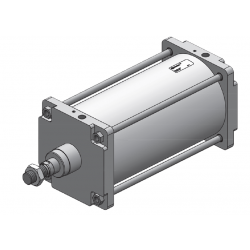
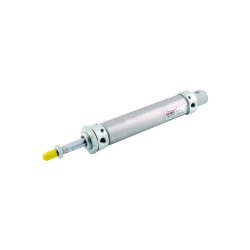
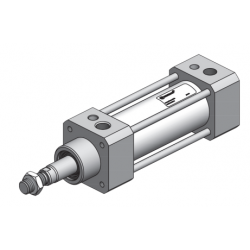
- Compared to hydraulic cylinders, it has a wide variety.
- There is a wide variety of cylinder types with standard and non-standard features.
- Cylinders produced for general applications can withstand operating pressures of up to 10 bar.
- Specially produced pneumatic cylinders should be used for higher pressures.
– Pneumatic Cylinder is the elements that control the compressed air energy and convert it into linear pushing or pulling motion.
– These cylinders, which convert pneumatic energy into mechanical energy, consist of a combination of parts such as front and rear cover, cylinder pipe, piston rod and sealing.
– Two things required for the Pneumatic Cylinder to work; the force and air release that enables the piston to move forward and backward.
- Compared to hydraulic cylinders, it has a wide variety.
- There is a wide variety of cylinder types with standard and non-standard features.
- Cylinders produced for general applications can withstand operating pressures of up to 10 bar.
- Specially produced pneumatic cylinders should be used for higher pressures.
- It is seen that the use of pneumatic movement and control systems has become widespread recently.
– Pneumatic Cylinder can operate at lower pressure than electric or hydraulic systems, thus reducing costs by providing more savings.
- On the other hand, these systems, which are convenient and easy, allow combination with other motion elements and can be integrated with modern control systems.
– Pneumatic cylinder is frequently used in industrial production where compression, pressure application, lifting or linear movement is required.
- These systems play an important role in many fields from press applications to the pharmaceutical industry, from iron and steel production to medical sciences.
- Upon the request of our customers, our company can manufacture in desired sizes and specifications or supply pneumatic cylinders in desired brands.